

Ask any DeFi user what their least favorite part of yield farming is, and you’ll hear the same answer: constant monitoring.
Rates shift. Vaults underperform. A lending market that yielded 6% yesterday drops to 3% overnight. You’re either manually moving capital between protocols every few hours or you’re leaving yield on the table. Most users just pick a vault and hope for the best.
The Rosetta team saw this problem differently. What if your capital could watch the markets for you — block by block — and move itself to the highest-risk adjusted opportunity the moment conditions changed? Not through a custodial vault that takes control of your funds, but through a smart account where you set the rules.
They built it. And $270 million in orchestrated volume later, it works.
Real Results from Real Users
Since integrating Biconomy’s infrastructure, Rosetta has delivered meaningful scale:
• $270 million+ in orchestrated volume routed through Biconomy
• Block-by-block yield tracking across multiple protocols and chains
• Zero custody risk — users retain full control of their funds at all times
• Instant execution — no delays, no manual intervention required
• Multi-chain expansion — live on HyperEVM, and Base, with Arbitrum launching imminently
Users deposit, decide what vaults they want exposure to, and earn. That’s it.
The Orchestration Problem
The intelligence layer wasn’t the hard part. Rosetta had already built sophisticated indexers that track yield rates block by block across every major lending and vault protocol. They could simulate future transactions to identify the optimal moment to move capital. They could calculate risk parameters, detect concentration risk, and flag when a vault’s utilization made withdrawals risky.
The hard part was execution.
Here’s what rebalancing yield positions actually requires in practice:
You need to withdraw from vault A. That’s one transaction. Approve tokens for vault B. That’s another. Deposit into vault B. That’s a third. Each step needs gas. Each step can fail. Each step requires a signature from the user.
And critically, Rosetta needed all of this to happen non-custodially. They didn’t want to hold user funds. They didn’t want users to trust a multisig or a custodial service. They wanted users to keep complete control — while still getting automated, intelligent yield optimization.
That’s a hard problem. You need smart accounts with granular permissions. You need an execution layer that can bundle multi-step operations atomically. And you need it all to work seamlessly so the user just sees their capital working.
The Solution: Orchestration with a Policy Layer
That’s where Biconomy came in.
“Biconomy is the spine of the B2C app we built.” — Hakan Rustemoglu, Head of Product, Rosetta
The integration connects Rosetta’s intelligence layer to Biconomy’s full infrastructure stack — Smart Accounts (Nexus), Sessions, and the MEE orchestration backend — creating a seamless product where users set the strategy and the system handles everything else.
Rosetta’s indexers handle the intelligence: tracking yields block by block, simulating future transactions, scoring risk parameters, and determining when and where to move capital. Biconomy’s infrastructure handles the execution: deploying smart accounts, enforcing permissions through Sessions, and executing multi-step rebalancing operations atomically.
Each stack stays in its strength zone.
How It Works in Practice
When a user arrives on Rosetta, here’s what happens behind the scenes:
1. Smart Account Deployment
The user connects with their externally owned account (EOA). Rosetta deploys a Biconomy Smart Account for them — a programmable sub-account that the user’s EOA governs. The user retains full ownership and control. Rosetta never touches the funds.
2. The Policy Layer (Sessions in Action)
This is where it gets interesting. The user navigates to Rosetta’s “Set Strategy” screen and sees a list of available yield sources — vaults from protocols like Aave, Morpho, Steakhouse, Gauntlet, Moonwell, Spark, and Seamless. Each vault is a toggle. The user switches on the ones they want to earn yield from, and switches off the ones they don’t. They can also choose to have exposure to all vaults.
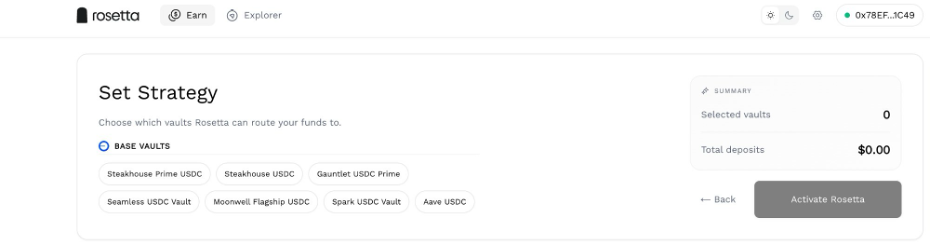
Under the hood, each toggle maps to a Biconomy Session — a granular, on-chain permission that defines exactly where user funds are permitted to go to. Toggle on Aave USDC? Rosetta can deposit into and withdraw from that specific vault. Toggle it off? Permission revoked. No blanket approvals. No custody risk. The user defines the rules.
3. Block-by-Block Intelligence
With the strategy set, Rosetta’s indexer goes to work. It tracks yield rates across every enabled source, block by block — even when no transactions are occurring. It simulates future transactions to detect optimal entry points. It evaluates risk parameters: current utilization, withdrawal risk, concentration risk (like detecting when a single account dominates a vault’s TVL on Morpho). It monitors continuously.
4. Orchestrated Execution via Biconomy
When conditions change — a meaningful yield jump in one of the enabled sources, validated against Rosetta’s risk parameters — Rosetta sends the orchestration instructions to Biconomy’s Orchestration service. Withdraw from vault A. Deposit into vault B. Biconomy composes the entire operation as a single, atomic supertransaction. No manual signatures. No gas management. No delay.
5. The User Experience
The user sees one thing: their capital, earning optimized yield, automatically. One deposit. One strategy selection. Continuous optimization.
Real Example from Production
A user deposits USDC into Rosetta on Base. They enable four yield sources: Steakhouse Prime USDC, Gauntlet USDC Prime, Moonwell Flagship USDC, and Aave USDC.
Traditional approach: User checks rates manually every few hours. Notices Moonwell’s rate dropped. Goes to withdraw. Pays gas. Researches alternatives. Finds Gauntlet is performing better. Approves tokens. Deposits. Pays gas again. Misses yield during the entire gap. Repeats tomorrow.
Rosetta approach: Rosetta’s indexer detects the rate shift in real time. Evaluates all enabled vaults. Confirms Gauntlet passes risk checks. Sends rebalancing instructions to Biconomy. Funds are withdrawn and redeposited in a single atomic transaction. User wakes up to optimized returns.
The Security Model
Non-custodial execution is the foundation of Rosetta’s design philosophy.
“We wanted smart accounts with a policy layer so we don’t touch the money and can orchestrate accordingly.” — Hakan Rustemoglu, Head of Product, Rosetta
The security model works on multiple levels:
User-Governed Smart Accounts. Every smart account is owned and controlled by the user’s EOA. Rosetta deploys and interacts with the account, but cannot override the user’s ownership.
Session-Based Permissions. Rosetta’s backend operates exclusively through Biconomy Sessions. Each Session is a narrowly-scoped, on-chain permission tied to a specific vault and action. The backend can only execute pre-approved operations. If it tries anything outside the user’s defined policies, the transaction fails on-chain. The guardrails are cryptographic, not just UI-level.
Risk Intelligence Layer. Beyond the permission system, Rosetta layers its own risk intelligence on top. Before executing any rebalancing, the system evaluates current utilization rates, checks for liquidity risks, and assesses whether the allocation could expose funds to withdrawal delays. The system both informs users and actively protects capital during orchestration.
What Users Are Saying
Users who are active on the platform consistently report a seamless experience. Execution is immediate — there are no delays or failed transactions. The most common feedback isn’t complaints; it’s requests for more: more yield sources, more vaults, more chains.
“In terms of the backend and functionality, we don’t receive much feedback because it executes immediately. There is no delay.” — Hakan Rustemoglu, Head of Product, Rosetta
That’s the kind of feedback you want — when the infrastructure disappears and users only think about what they’re earning.
Why This Matters for DeFi
Rosetta’s integration demonstrates a pattern that’s becoming central to DeFi’s evolution: intelligence layers paired with modular execution infrastructure.
The yield optimization problem is fundamentally a two-sided challenge. You need sophisticated data analysis and decision-making on one side, and reliable, non-custodial, atomic execution on the other. Building both from scratch is a massive lift. Building one and plugging into best-in-class infrastructure for the other is how you ship faster and ship better.
With Biconomy, Rosetta got Smart Accounts for non-custodial user control, Sessions for granular permission management, and MEE for atomic multi-step execution — all out of the box. With Rosetta, users get intelligent yield optimization that actually delivers on its promise of “set it and forget it.”
Ready to optimize your yield automatically?
Try Rosetta: rosetta.sh
Learn about Biconomy’s infrastructure: Docs